
Market Site
Consider the layout of your market carefully.
Your site map will determine vendor placement, customer traffic flow, accessibility, and where to locate key features like entertainment areas, seating, and facilities. It's an essential communication tool for keeping vendors, staff, and customers on the same page - literally!
-
Part of the Nebraska Rural Farmers Market Handbook, check out pages 40-43 for basic strategy of where to place vendor booths on your site.
-
OFMA is building a folder with examples of site maps used at markets around Oregon. Check out what’s here for inspiration, or help others by adding your own market’s map!
-
More examples of site maps collected by the WA State Farmers Market Association:
-
Some markets invest in dedicated market management software. These platforms can track vendor schedules and stall sizes, then automatically populate a map from a site template you upload. This can save time as your roster shifts throughout the season. That said, markets have mixed experiences with how easy or difficult it is to upload or update that base template, so it's worth asking about it specifically when evaluating software options.
Others prefer design tools like Canva or Photoshop. A common approach is to grab a Google Maps image of your site and use the design software to overlay squares and shapes representing vendor stalls and other infrastructure. To work to scale, measure a known distance on your actual site and use it as your reference. Since the standard vendor stall is a 10'×10' tent, finding a 10-foot length to work from is the most useful starting point.
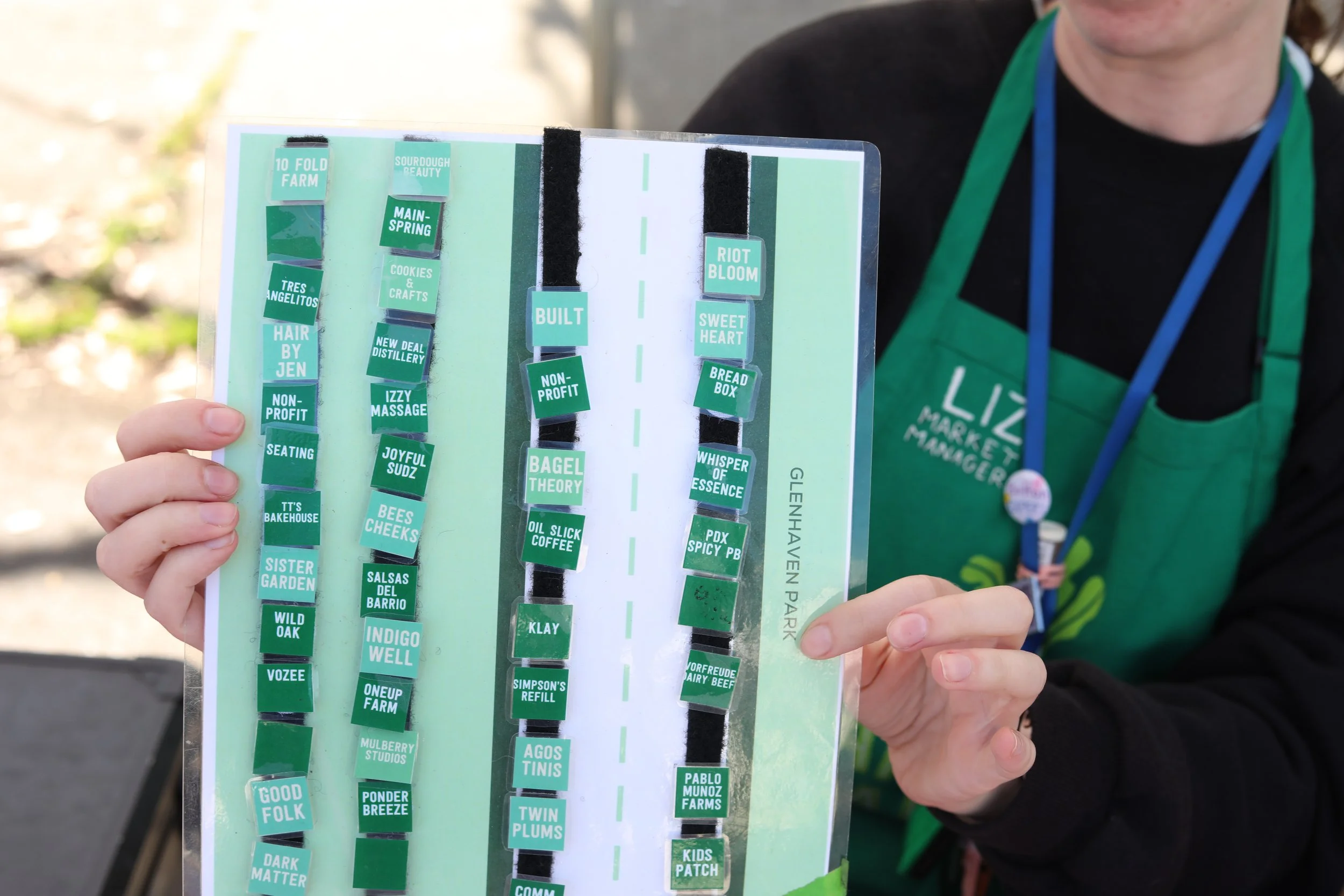
Low-tech methods can work surprisingly well too. Some DIY maps OFMA has seen include:
a hand-drawn grid on paper
sticky notes representing vendor stalls, placed on a whiteboard
scrabble tiles, or blocks, arranged on a printed base map
a corkboard that lets you pin and repin vendor cards
The key requirement, whatever your method, is flexibility. Vendor schedules shift throughout the season, and some vendors need to increase or shrink the number of stalls they use depending on how much space their harvest requires. Your physical layout may change too. A school parking lot might open up significantly more space in summer than fall, for instance. Whatever method you choose, you need to be able to rearrange things easily and update your map quickly.
A complete market site map should account for:
Vendor stalls, including size and any variations (single, double, or half stalls)
Entrances and exits for customers
Vehicle entrances, exits, and drive-through routes
Load-in and load-out zones
Parking areas for customers, vendors, and staff
Accessible pathways and ADA-compliant routes
Restrooms, including accessible facilities
Water access and utility hookups
Power sources and electrical hookups
Seating and gathering areas
Entertainment or demonstration areas
Information booth or market headquarters
First aid station
Emergency exits and evacuation routes
Signage and banner placement locations
Trash, recycling, and compost stations
Storage areas
Neighboring buildings, roads, or fixed features that affect the layout
Not every item will appear on every version of your map. Your public-facing map probably doesn't need to show electrical hookups, but your vendor map definitely does. Keep your audience in mind as you decide what each version needs to communicate.
-
Where you place vendors on your map matters more than it might seem at first.
A popular vendor positioned at the far end of the market draws customers through the whole space rather than letting them turn around halfway. A flower vendor near the entrance entices people to walk in. Complementary vendors placed side by side can benefit both: think of a chimichurri maker next to a rancher selling local meats, for instance. Some vendors need shade and should be positioned out of direct sun where possible. Another might tend to run late, and placing them at the edge of the market could be the best way minimize disruption when they need every last second to set up before the market opens.
There are also the less tangible considerations: balancing the seniority of longtime vendors who've earned their preferred spots against the needs of newer vendors who may need high-traffic placement to build a customer base.
Vendor placement is the kind of topic market managers can talk shop about endlessly, and it's genuinely one of the best things to learn from people with experience. OFMA networking events are a great place to make those connections and swap hard-won knowledge with other market staff.