
Community and Belonging
Farmers markets operate inside a food system shaped by racism and exclusion.
Market managers don’t have to carry that forward into their markets today, and the resources on this page can help. Use them to understand the forces involved, recognize how they show up in your market, and take action toward a more equitable and welcoming community space.

Toolkits Made for Farmers Markets
-
Two Indigenous community members, S.A. Lawrence-Welch (Nêhiýaw & Métis) and Vawn Jason Borges (Kānaka Maoli). created OFMA’s Native Knowledge Sharing Toolkit, a resource to encourage markets to ask questions and reflect on their own experiences, while learning some hard truths about Oregon, this land, and its people.
-
When farmers of color join your market, it’s a given that you’ll welcome them, but will you welcome them with anti-racist policies and procedures that support all your vendors in having successful market experiences?
Allinee “shiny” Flanary is an Oregon-based farmer and market manager whose work examines how policies and systems have contributed to farmers markets being predominantly white environments. She created the Making Progress toolkit for Oregon market managers who want to do things differently. It begins with guiding assumptions about race and racism, looks at systems and the history that shaped Oregon, and then defines anti-racism as an ongoing practice, closing with five things your market can go do now.
-
Farmers markets are part of a food system that has kept farmers of color from building lasting, intergenerational success in agriculture. Your farmers market can be an incubator for social change, a market known for taking action to change the status quo such that meaningful change occurs for Black and Brown vendors, shoppers, and community members.
Allinee “shiny” Flanary, an Oregon-based farmer and market manager, created this guide to help fellow market managers build the conditions to make that happen.
Open the toolkit to learn:
Market Types + Models: Understand the types of markets and operating models, and evaluate whether yours is the best fit for making social change a lasting part of your mission.
Come Thru Market: A Case Study: See how a Portland market hosts a BIPOC farmer training program and heavily subsidizes vendor fees, with tips for BIPOC vendor engagement.
Farmer Training Program: Learn to put the training curriculum into practice. It’s free and open to anyone to use.
-
The Anti-Racist Farmers Market Toolkit was developed by a group of Black food systems leaders and market managers from across the country. It helps managers put anti-racism into practice, both by reflecting on their organizations and by making needed changes to the structure, design, and operations of the market itself.
Written primarily for market managers and decision-makers, it uses a framework of the four M’s to organize the work: Management, Mission, Messaging, and Measurement.
Access the toolkit through the Farmers Market Coalition, or download it from OFMA’s resource library files.
-
Farmers markets have seen a major increase in political activity, which can interfere with both day-to-day operations and efforts to put DEI commitments into practice. These materials come from a workshop on organizing tools for combating white supremacist activities at farmers markets and other public places, with a focus on creating inclusive, anti-racist food system spaces. OFMA and Amy Herzfeld-Copple of Western States Center presented the session at OSU’s Small Farms Conference in 2020.
More Resources and Readings
-
US Food System Timeline compiled by Tracy Gagnon, Oregon Food Bank, documents the history exploitation of land and food workers in the U.S. and Oregon and highlights examples of resistance from communities of color.
-
4 Not-So-Easy Ways to Dismantle Racism in the Food System, an article by Leah Penniman, in Yes Magazine.
-
Dismantling Anti-Black Bias in Democratic Workplaces is a toolkit from AORTA to equip workplaces with tools to see and address anti-Black racism when it happens and create systems and practices that undermine anti-Black racism.
-
The Racist History of Portland, the Whitest City in America, an article by Alana Semuels, from The Atlantic
-
A Hidden History: OR Black History Timeline is a timeline of the stories and struggles of Oregon’s African American community. By Walidah Imarisha, Oregon Humanities Conversation Project
-
The Ongoing Impact of Racism on the U.S. Farming Landscape despite some progress in diversity and racial justice in the US, as a whole, a professor argues that farming remains deeply segregated. By Megan Horst, Civil Eats
Webinar Recordings
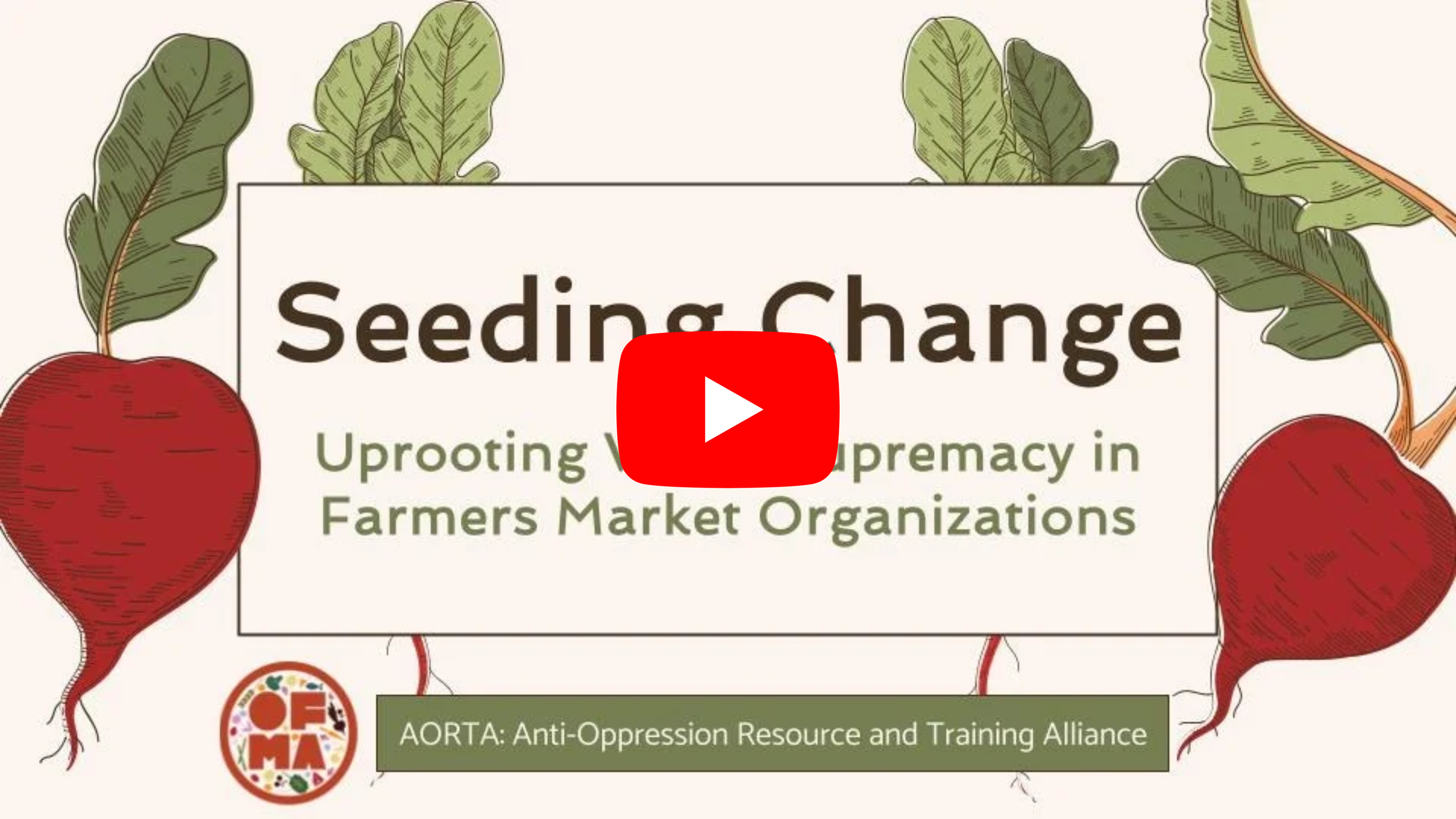
This series of workshops, hosted by OFMA and facilitated by Sunny Dakota Spencer of AORTA (Anti-Oppression Resource and Training Alliance), helps market managers build more equitable markets.
The sessions cover how white supremacy culture shapes organizations, policies, and everyday interactions, then turn to practical skills and changes: responding when you witness racism, giving and receiving feedback without defensiveness, and restructuring your market to increase racial equity and support vendors and managers of color. The most recent session focuses on defining what equity means for your own market and putting your values into practice.
Each session stands on its own, so start with the topic most useful to your market.
When farmers of color join your market, it’s a given that you’ll welcome them, but will you welcome them with anti-racist policies and procedures that support all your vendors in having successful market experiences?
Allinee “shiny” Flanary is an Oregon-based farmer and market manager whose work examines how policies and systems have contributed to farmers markets being predominantly white environments. She created the Making Progress toolkit for Oregon market managers who want to do things differently. It begins with guiding assumptions about race and racism, looks at systems and the history that shaped Oregon, and then defines anti-racism as an ongoing practice, closing with five things your market can go do now.
Use this webinar as an introduction, then follow up with shiny’s toolkit for more depth, context, and actions than we can cover in one session.